
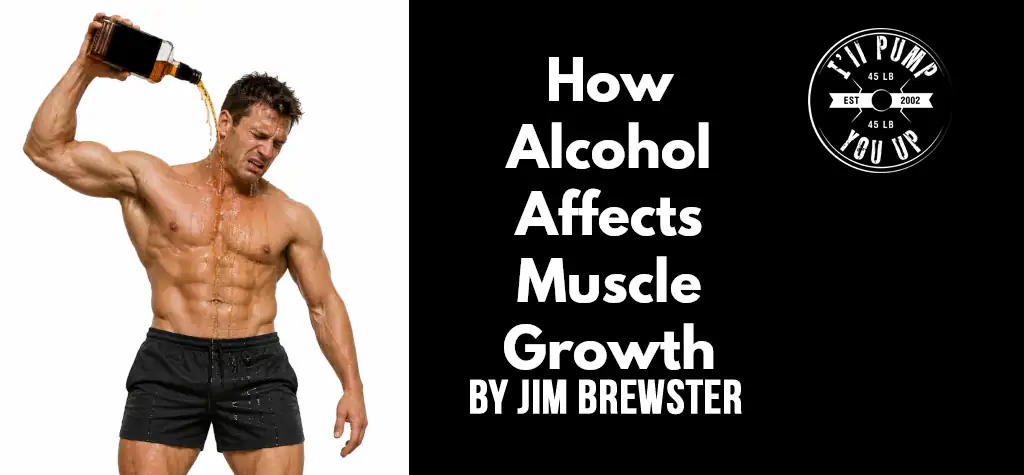
How Alcohol Affects Muscle Growth
How Alcohol Affects Muscle Growth – you might wonder about that if you’re someone that likes to grab a cold beer after training. Or perhaps you like to party 3-4 nights a week. So how does that impact your gains? I will answer that question and more in this article, and provide solutions. Let’s get right to it!
| Alcohol Nutritional Highlights | Cons | Tips |
| Can have a lot of calories depending on the drink | Impairs protein synthesis | Don’t drink close to a workout |
| No nutritional value | Lowers free testosterone | Limit yourself to 3 drinks |
| Spikes cortisol | Do not drink every day | |
| Negatively affects sleep | ||
A Quick Look At Alcohol
While calories are not the primary problem, there are 49 calories per 4 ounces in a typical can of beer. In comparison, 4 ounces of 80 proof vodka contains a whooping 261 calories! Right off the bat, we see that alcohol can add quite a bit of useless calories to your diet, depending of course on your drink of choice.
When a lifter drinks the alcoholic beverage of their choice, it goes to the liver to be metabolized. Once there, it breaks down into ethanol, a toxic by-product. After you’ve had your drink or drinks, your body’s primary task is to metabolize the ethanol into less harmful by-products which then become a potential energy source. That’s fine, but the process of metabolizing alcohol interrupts other energy production pathways.
The body uses specific molecules in order to digest and break down food (primarily carbs) for energy. Alcohol short-circuits the ability of the body to burn carbs (as well as fatty acids) because it dominates the needed molecules, thereby reducing their availability. The point is, the production of ATP your muscles require when you train will be hijacked. In my mind, that alone is reason enough to not drink, or at least to severely limit, alcohol.
The Effect Of Alcohol On Your Hormones
How Does Alcohol Affect Testosterone?
There can be no doubt that testosterone is one of the most anabolic hormones in the body. The question any serious lifter should be asking is: “How does a few drinks affect testosterone”?
Well, if you like to drink, the answer is one you are not going to like. But, if you are serious about lifting, drinking booze should not be a priority. Heavy alcohol consumption decreases production of testosterone. The thinking on this is that it causes damage to the cells that are responsible for the production of testosterone. It is also thought that it causes inflammation in the body. This, in turn, limits the production of testosterone.
And as mentioned, alcohol affects many other hormones that are responsible for your performance in the gym as well!
Alcohol Is Catabolic – Its Impact On Cortisol
Every dedicated lifter knows that cortisol is a catabolic hormone that can stop your gains dead in their tracks. The bad news is, alcohol increases levels of cortisol and the longer they are elevated the greater the potential for catabolism to occur. Not only that, alcohol reduces GH output which in turn has several negative effects on your muscles and body. as negative effects on blood sugar maintenance and metabolism of muscles, bones, and the brain. We’ve already seen what alcohol does to testosterone production, it also increases estrogen levels, which is catastrophic for serious lifters.
It Doesn’t Stop There!
Besides the above problems alcohol also has a negative effect on hormones in general and on your metabolism. Finally, once alcohol is metabolized it produces molecules that can damage other cells in your body.
Does Alcohol Negatively Affect Muscle Growth?
Studies suggest that alcohol negatively affects cellular signals that promote muscle growth, especially in male lifters. Have you seen the commercial that shows a few guys working out, and then shows them drinking a beer when they’re done? Studies show what a catastrophic mistake this can be – research has found that drinking close to a workout lowers protein synthesis rates. What is that bad, you might ask? Because protein synthesis is a direct trigger of muscle growth!
Other research suggests that alcohol near your workout reduces free testosterone levels. Again, this is critical because free testosterone is the amount of testosterone the body has available for functions such as muscle growth. It’s not much to begin with – the body uses 97 to 98% of all available testosterone for normal bodily function. That miniscule 2-3% is all that’s left – and alcohol lowers it even more!
In addition, alcohol impairs nutrient absorption – a critically serious problem for any hardcore lifter! If you’re using a great pre-workout with potent nitric oxide boosters – which besides the pump also enhance nutrient delivery to your muscles – why would you then turn around and drink something that derails the absorption of those nutrients? Even if it’s hours later before you have a drink (or drinks), you’re ingesting nutrients with every meal, snack, and shake.
Now, I would like to think that no serious lifter runs for a beer after they train – but I would not be surprised that some lifters probably do. If this describes you, you need to put down the drink and grab a protein and carb post-workout shake instead! Otherwise, you are destroying your gains! (1, 2, 3, 4, 5)
Does Alcohol Negatively Affect Recovery?
Once you’ve finished your workout, your body begins the process of recovery. It’s thought that this process lasts up to 24 hours (some sources will say as long as 48 hours). What you do during this timeframe (your nutrition, sleep quality, and activity level) will determine your body’s rate of protein synthesis. Alcohol ingested in this timeframe can have a negative impact on your ability to recover, specifically your ability to build new muscle growth. (6)
How Does Alcohol Affect My Supplement Program?
Consuming alcohol, especially if ingested after a workout, derails supplements like protein powder because, as noted, it lowers the body’s anabolic response, decreases free testosterone while increasing cortisol, and slows the absorption of nutrients. (7)
Timing Matters:
- Post-Workout (2 hours) – Alcohol consumption in this timeframe is the most damaging to recovery.
- Post-Workout (2-24 Hours) – Alcohol will still slow protein synthesis,but it will not be as damaging as drinking immediately after a workout.
Contrary to the beer commercial suggesting a “cold one” after training, it’s not a good idea. To be brutally honest, for any serious lifter, when you can have a drink is most likely at the very bottom of their list of priorities.
How Much Is Too Much?
Drinking in moderation is one thing, but exactly how many drinks does that work out to be? According to research, the answer is 1 drink per day for women, and 2 drinks per day for men.
That may not seem like much to the young buck that likes to party heavy multiple times a week, but if you are serious about your gains, you will make it work. And, for some of us, zero drinks a day works just fine! (8)
If You Plan To Drink, Rehydrate!
We have established that you should avoid consuming alcohol in the hours around your workout. The later you wait the better. Once your workout is over, make sure you have a post-workout shake within 15 minutes. For example, Hi-Tech Precision Protein mixed with a simple carb source, such as fruit, flavored yogurt, or fruit juice. It’s important to maintain hydration, and that includes later on if you intend to drink. I suggest Axe & Sledge Hydrate.
Also, your pre-workout may have a hydration complex, such as Gorilla Mind Gorilla Mode, with 1 gram of Pink Hima;ayan Sea Salt and 4 grams of HydroPrime glycerol. In addition, make sure you’re taking a good multi, such as AllMax Nutrition VITASTACK.
Of course, eat like you mean it by ingesting 1 gram of protein per pound of bodyweight (at least) for men, and .75 grams per pound for women. Focus on complex carbs, consuming your simple carbs in the hours around your workout (50% of the day’s carbs should be taken in this timeframe).
If you feel you must drink, staying on top of your supplement and nutritional program helps offset the negative effects of alcohol.
Summary
Now that we’ve seen How Alcohol Affects Muscle Growth, it should be clear that it has little place in the overall arsenal of the serious lifter. Sure, have an ice-cold beer, but keep it where it belongs: at or near the bottom of your list of priorities. In the meantime, one of your top priorities is to stop by illpumpyouup.co and stock up – you do not want to run out!
References:
- https://journals.lww.com/nsca-jscr/Fulltext/2017/01000/Effect_of_Acute_Alcohol_Ingestion_on_Resistance.7.aspx
- https://academic.oup.com/alcalc/article/37/2/169/101021?login=false
- https://www.ncbi.nlm.nih.gov/pmc/articles/PMC3258349/
- https://www.ncbi.nlm.nih.gov/pmc/articles/PMC4420901/
- https://www.ncbi.nlm.nih.gov/pmc/articles/PMC7739274/
- Burd, N. A., West, D. W., Moore, D. R., Atherton, P. J., Staples, A. W., Prior, T., Tang, J. E., Rennie, M. J., Baker, S. K., & Phillips, S. M. (2011). Enhanced amino acid sensitivity of myofibrillar protein synthesis persists for up to 24 h after resistance exercise in young men. The Journal of nutrition, 141(4), 568–573. https://doi.org/10.3945/jn.110.135038
- Parr, E. B., Camera, D. M., Areta, J. L., Burke, L. M., Phillips, S. M., Hawley, J. A., & Coffey, V. G. (2014). Alcohol ingestion impairs maximal post-exercise rates of myofibrillar protein synthesis following a single bout of concurrent training. PloS one, 9(2), e88384. https://doi.org/10.1371/journal.pone.0088384
- https://www.cdc.gov/alcohol/about-alcohol-use/moderate-alcohol-use.html