

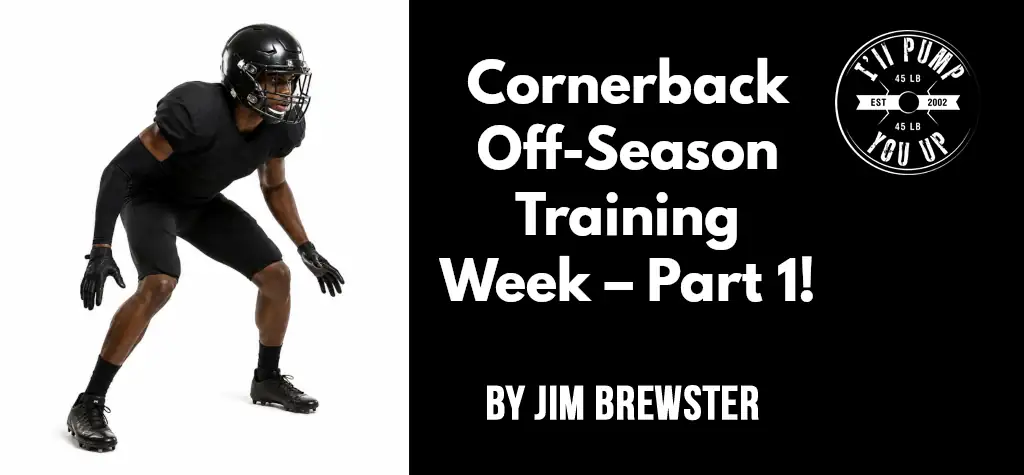
Cornerback Off-Season Training Week – Part 1!
Ah, the cornerback – a major star of the defense! My 2-Part Series takes a comprehensive look at a typical Cornerback Off-Season Training Week. We will focus on several key factors, so let’s jump into Part 1 and find out more – and then jump into Part 2!
A Quick Recap – Cornerback Off-Season Training Week!
| Day | Focus | Primary Training Elements |
| Monday | Linear Speed & Lower Body Power | Flying 20s, Bounds, Heavy Squats & Hinges |
| Tuesday | Change of Direction (COD) & Upper Pull | Shuffle-to-Bail Drills, Weighted Pull-ups, Rows |
| Wednesday | Active Recovery & Mobility | 90/90 Hip Switches, Light Barefoot Balance, Extensive Flexibility |
| Thursday | Acceleration & Lower Body Hypertrophy | Sled Pushes, Medicine Ball Throws, Unilateral Strength |
| Friday | Fluidity, Footwork & Upper Push | W-Drill, Linebacker Mirror Variances, Bench Press, Dips |
| Saturday | Low-Intensity Conditioning | Extensive Tempo Runs, Dynamic Walks |
| Sunday | Full Rest | Total Physical and Mental Recovery |
An Example Off-Season Cornerback Training Week
In today’s football, the cornerback position is one of the most athletically demanding of any position. The cornerback position is reactionary, meaning they must mirror the wide receivers on the other side of the ball who have one key advantage – they know the route they’re about to run.
Success in the defensive backfield is determined by much more than speed. It also includes the ability of the player to change direction, decelerate quickly as needed, and utilize unilateral power as required. To that end, the following training week example will feature several unilateral movements, among other key elements.
Mechanics – 4 Critical Errors The Cornerback Must Correct!
Before hitting the field, the cornerback must fix common movement mistakes that give wide receivers an advantage. Good training is not just about getting stronger—it is about removing wasted movement.
1. The “False Step” (The Wasted Step)
- The Mistake: When a cornerback stops moving backward and tries to sprint forward or turn, they take a small, accidental step backward first, instead of just driving off their back foot.
- The Cost: This bad habit wastes a fraction of a second. Against fast college-level receivers, that small delay gives the receiver an extra 3 to 6 feet of wide-open space.
- Why It Happens: The player’s ankles and calves are too soft. Because their foot cannot instantly handle the force of stopping, the body forces them to take an extra step to regain balance.
- The Fix: Train the ankles to act like stiff, bouncy springs. Use Ankle Pogo Jumps to teach the feet to bounce off the ground instantly. Pair this with the W-Drill, focusing on planting the foot and exploding forward immediately without any extra steps (1).
2. Standing Too Tall When Stopping
- The Mistake: When a receiver stops suddenly to catch a short pass, the cornerback tries to stop while keeping their upper body straight up and down.
- The Cost: Standing too tall makes it hard to slow down. The cornerback will take 4 or 5 extra sloppy steps to stop, causing them to slide right past the receiver.
- Why It Happens: The player has weak hamstrings and glutes. Stopping a fast run requires a player to drop their hips low to the ground, which puts a massive amount of weight and stress on the back of the legs (1, 2).
- The Fix: Use Dumbbell Romanian Deadlifts (RDLs) to make the hamstrings strong enough to handle sudden braking forces. On the field, practice the Pro Agility Shuttle and focus on dropping the hips low enough to touch the ground at every turn (1, 2).
3. “Lunging” Instead of “Driving” in Press Coverage
- The Mistake: In close-up press coverage, a young cornerback often leans their entire upper body forward to punch the receiver, throwing all their weight onto their toes before their feet even move.
- The Cost: The cornerback instantly loses their balance. A smart receiver will simply slap the defender’s hands away and run right past them.
- Why It Happens: The player is trying to punch using only their arms, rather than pushing from the ground up through a tight, solid core.
- The Fix: Use the Standing Pallof Press to teach the stomach muscles to stay rigid and locked. When doing the Barbell Bench Press, focus on explosive power so the player learns to deliver a strong punch from a steady, balanced stance instead of an off-balance lean.
4. Crossed Feet and Tight Hips When Running Backward
- The Mistake: When turning around to run deep with a receiver, the cornerback swings their back leg too wide or accidentally clips their own heels.
- The Cost: The player wobbles, loses speed, or trips over their own feet.
- Why It Happens: Tight hips. If a player’s hip joints are stiff, they cannot flip their lower body around smoothly while keeping their eyes on the quarterback (1, 2).
- The Fix: Loosen the hips and wake up the side-glute muscles. Do 90/90 Hip Switches before every workout to open up the hip joints. Follow up with Lateral Band Walks to keep the legs moving along a wide, stable base without crossing over (1).
Day 1 – Linear Speed & Lower Body Max Strength
Nutrition Tips – Always eat at least one meal before you start your training day. Your meal (or meals) should be made up of lean protein sources and a combination of simple and complex carbohydrates which provides immediate as well as extended energy. Generally speaking for cornerbacks (more detail later in this Series), I advocate 1 to 1.5 grams of protein and 2.5 to 3.5 grams of carbs per pound of bodyweight. (1)
Hydration is another key point – always, always, always start your day with 1-2 glasses of water, and stay hydrated throughout your day! While you could choose to drink one of those popular sports drinks, I suggest Liquid I.V. Hydration Multiplier or Axe & Sledge Hydrate.
Supplement Tips – I always advise drinking 1 serving of EFX Sports Karbolyn mixed with 1 to 2 servings of NutraBio EEA Pure 30 minutes before you start training.
The objective of Day 1 is maximum central nervous system (CNS) stimulation, focusing on top-end linear velocity and absolute lower-body power.
Speed & Plyometric Warm-Up
Single-Leg Diagonal Bounds
3 sets x 5 “bounds” per leg – To develop explosive unilateral power, stride frequency, and multi-directional hip stability.
- Start in an athletic, staggered (one leg slightly behind the other), half-squat position.
- Explode diagonally off your outside foot, driving your opposite knee up and forward.
- Stick the landing on the opposite leg by absorbing the force primarily through your ankle and glute. Hold the leg you jumped off with up from the ground with your knee bent 90 degrees.
- Immediately bound back in the other direction.
- Focus on minimizing ground contact time, staying on the balls of your feet like you would during a pogo jump.
Linear High Knees
2 sets x 20 yards – Focuses on front-side running mechanics and hip flexor recruitment.
- Stance – Maintain a slight forward lean while keeping your hips back and your core engaged.
- Knee Drive – Drive your knees aggressively upward until your thighs are parallel to the ground, bringing your ankles locked and your toes upward.
- Arm Action – Drive your elbows back as if you are trying to push away an opponent on your back.
- Foot Strike – Drive your foot straight down into the turf beneath your body using a swift, striking motion.
Sprinter Step-Up Launches
3 sets x 3 reps each leg – Builds explosive unilateral power and speed.
- Starting Stance – Place one foot firmly on an elevated surface like a plyometric box, bench, or step. Assume a sprint start position, with the arm opposite your front leg extended forward and the other arm back. Keep your shin at a slight forward angle with your weight distributed through the ball of the foot.
- Drive – Initiate the movement by driving the foot on the box forcefully downward.
- Jump & Drive – Fully extend the hip, knee, and ankle of the working leg to jump vertically. Simultaneously, drive your trailing knee forward and up toward your chest, while pumping the opposite arm forward.
- Land & Reset – Land on the same working leg and allow your hips to hinge backward to safely absorb and decelerate the forces. Reset and repeat
Flying 20s
1 “set” x 4 reps – Build speed smoothly for 20 yards, maintain absolute maximum velocity for 20 yards, then decelerate safely over 20 yards.
Lifting – Cornerback Off-Season Training Week!
I recommend the use of a pre-workout but it is optional. For football, the one I suggest is Kaged Pre-Workout because it has BCAAs (unusual for a Pre) a “Strength & Power matrix” and, using one scoop, a moderate amount of caffeine. I would mix in a serving of Karbolyn (feel free to use 2 scoops as desired).
Once you finish your workout, drink a post-workout shake consisting of Hi-Tech Precision Protein mixed with fast and slow digesting carbs.
Barbell Back Squat
20% 1RM x 15 reps
40% 1RM x 10 reps
50% 1 RM x 10 reps
4 sets x 4 reps at 85% 1RM – Builds the baseline structural strength required to generate high ground reaction forces.
Barbell Pendlay Row
4 sets x 6 reps – Develops strict upper-back power to balance horizontal pressing mechanics.
Dumbbell Romanian Deadlift (RDL)
3 sets x 8 reps – Trains the hamstrings eccentrically to safeguard against sprinting injuries.
Weighted High Plank
3 sets x 45 seconds – Teaches the core to stay rigid under an external load.
Day 2 – Change of Direction & Upper Body Pull
Nutrition Tips – Same as Day 1.
Supplement Tips – Same as Day 1.
This session focuses on planned movement transitions and upper-body pulling strength to balance the posture of defensive backs.
Agility & Hip Transition Drills
90/90 Hip Switches
2 sets x 8 reps each side – Improves internal and external rotation of the hip joint capsule.
- Set Up – Sit down on the floor, bending both your knees to a 90-degree angle: your front thigh should be pointing straight ahead, and your back thigh pointing out to the side.
- Support – Place your hands on the floor behind you for balance while keeping your chest upright.
- The Switch – Lift your knees off the ground, pivoting on your heels, and rotate your legs to the opposite side.
- Completion – Lower your legs back down until both shins are resting on the floor, mirroring the 90/90 position on the new side.
Lateral Shuffle to Sprint
3 “sets” x 2 “reps” per side – Builds the crucial hip mobility, low pad level, and explosive change-of-direction speed needed to mirror receivers and defend the run.
- Set Up – Place three cones in a straight line 5 yards apart from each other.
- Starting Stance – Line up in an athletic position with your hips pushed back, knees bent, and toes pointing straight ahead.
- Athletic Stance – Bend your knees and push your hips into a quarter-squat position while keeping your chest up, your core braced, and your back flat.
- The Shuffle – Push off of your inside foot to shuffle laterally towards the second cone. Keep your shoulders square, feet low to the ground, and do not let your feet cross or hit each other.
- The Break – Immediately upon reaching the second cone, plant your outside foot, open your hips 90 degrees, and explode into a sprint to reach the final cone.
Pro Agility Shuttle (20-Yard Shuttle)
1 “set” x 4 reps – Focus on dropping the center of mass and driving the hips through the turn.
Equipment and Placement: You will need 3 cones and 15 yards of space. Set the three cones in a straight line 5 yards apart from each other.
- Stance – Straddle the center cone using the athletic stance already described. Drop your hand to the ground on the side you plan to move first.
- First 5 Yards – Explosively push off and sprint 5 yards to the first outside cone. Touch the ground at or just past the cone with your hand.
- The 10-Yard Turn – Drive off your outside foot, flip your hips, and sprint all the way to the opposite outside cone. Touch the ground or just past the cone with your hand.
- The Finish – Sprint back through the starting center cone.
Shuffle-to-Bail Drill
4 reps x 10 yards.
Begin in a lateral shuffle, then instantly snap the hips open 45 degrees into a vertical run without altering pad level.
Here’s a definition of “opening the hips”: opening the hips means rotating your pelvis and thighs outward to expand a player’s field of vision and change direction efficiently.
Lifting – Cornerback Off-Season Training Week!
Supplement Tips – Same as Day 1.
Lat Pulldown (Feel free to warm-up on these and then switch to weighted pull-ups for your heavy sets)
20% 1RM x 15 reps
40% 1RM x 10 reps
50% 1 RM x 10 reps
4 sets x 5 reps – Builds vertical pulling power and shoulder girdle health.
Incline Dumbbell Press
3 sets x 8 reps – Develops upper chest power relevant to the hand-placement angles of a press jam.
Dumbbell Rear Delt Fly
3 sets x 12 reps – Targets the posterior deltoids to prevent rounded shoulder posture.
Standing Pallof Press
3 sets x 10 reps per side – Trains anti-rotational core stability to keep the spine rigid during physical coverage.
Performance Notes
When you are lifting, you should perform the concentric phase of your reps explosively. Do not rush through your reps or let momentum do your work. In the eccentric phase of the rep, lower the weight slowly and under complete control. I advise lifting this way regardless of the position you play.
Summary
That brings Part 1 of my Cornerback Off-Season Training Week Series to a close! In this article, we’ve seen the first 2 training days, and I have also included performance tips, nutritional guidelines and supplement suggestions. In Part 2, we will look at the remaining 5 days of training, so let’s get right to it!
References:
- Nimphius, S., Callaghan, S. J., Spiteri, T., & Lockie, R. G. (2016). Change of direction deficit: A more isolated measure of change of direction performance than total time. Journal of Strength and Conditioning Research, 30(11), 3024-3032. (Establishes the scientific framework for deceleration metrics and route-breaking mechanics).
- National Strength and Conditioning Association. (2021). Developing Speed. Human Kinetics. (Chapter 7: Explains the exact mechanical guidelines and center-of-gravity principles utilized in defensive back agility development).