

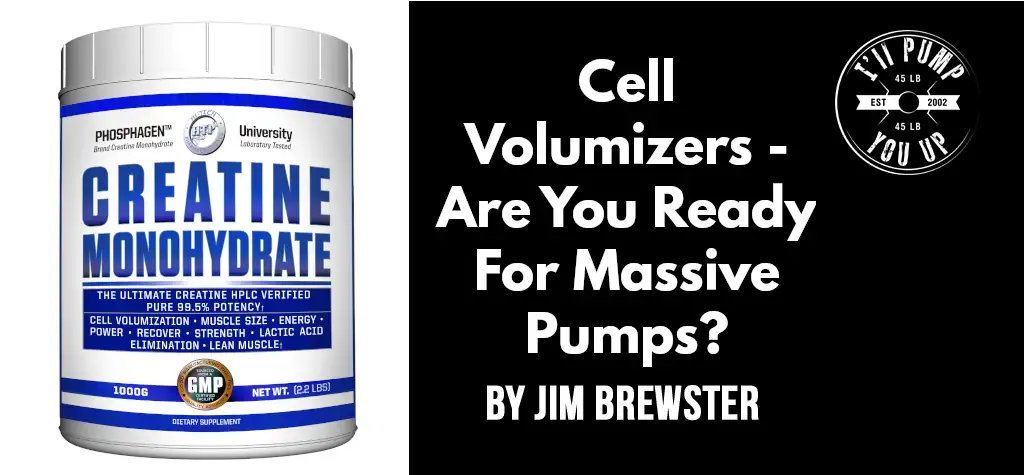
Cell Volumizers – Are You Ready For Massive Pumps?
To answer the question asked by the title of this article, there’s no doubt any serious lifter is ready for massive pumps! But, I’m not talking strictly about nitric oxide boosters – I’m talking about cell volumizers. In this article, I will detail which ingredients increase muscle cell volume and how to get the best results using these compounds. So if you’re ready, let’s rock!
What Are Cell Volumizers?
Cell volumizers are supplements that create water-based pumps. Unlike pump boosters that work by increasing nitric oxide production, these products increase muscle cell volume by pulling water into your muscle cells, causing them to swell in size. Supplement ingredients that do this are called osmolytes. What does that mean, you might wonder? An osmolyte is a molecule that acts as a water magnet. They play a major role in the fluid balance of the body. (1)
Creatine Monohydrate – The Original Cell Volumizer
Creatine monohydrate was the first cell volumizer. Back in the early 90’s, there was nothing available that promoted a pump the way nitric oxide boosters did, and the concept of cell volumizers did not exist. Then creatine came along. Since then, there have been several ingredients that have come along with similar osmotic properties. With the introduction of these products, the supplement industry has never been the same. In terms of cell volumizers, we not only have creatine, we also have taurine, betaine, and glycerol.
I’d like to note that one of the men responsible for the original Phosphagen creatine monohydrate supplement, Ed “Mr. Creatine” Byrd, also introduced the original NO2, the first nitric oxide booster, several years later. His company at that time was MRI, a company that is still in business right here in 2026.
Massive Pumps
The key to massive pumps is to not only use a product with nitric oxide boosters, but to also use one with cell volumizers. In the next section, I will list each cell volumizing ingredient and provide product suggestions.
I should add that there is more to great pumps, such as drinking plenty of water, eating most of your carbs close to your workouts, and not taking long rests between sets. I will cover some of these topics in upcoming sections.
As far as rest, I personally only rest about 20-30 seconds between sets. I’m not saying you have to, but moving fast promotes dramatically better pumps than sitting on the equipment playing with your phone for 10-15 minutes between sets. So put that phone away and get in there and get it done!
Suggested Supplements
Here is the list of cell volumizers with product suggestions.
Creatine Monohydrate
This exceptional product features CreaSyn®, which is a patented micronized creatine monohydrate.
Betaine Anhydrous
This phenomenal pre-workout is a great source of betaine, mainly because it is dosed at 4,000 mg, which is considerably higher than most other pre-workouts and pump products.
Betaine, also known as TMG or trimethylglycine, occurs naturally in beets. Technically, it’s the amino acid glycine with three methyl groups attached. It is available as a stand-alone supplement, but it’s common as a pre-workout ingredient. Betaine is not only an osmolyte, it is also often compared to creatine in terms of such benefits as increasing strength and power. (2)
Taurine
Taurine occurs naturally in the body and is found in our muscles, eyes, heart and brain. It does have cognitive benefits which is why you see it in many energy drinks. The average consumer has no idea what it is, so it often gets a bad rap. So what is it? Taurine is a nonproteinogenic amino sulfonic acid, or an amino acid that is not involved in the creation of protein. Beyond its cognitive benefits, it’s in many pre-workouts for its osmotic properties. (3, 4)
Glycerol
Pump2 contains 6 grams of GlycerSize®, a patented form of glycerol. You can go up to 20 grams, but you’re getting 4 grams of a patented glycerol with Gorilla Mode, and you will find that 10 grams of patented glycerol is tremendously effective.
What Is Glycerol?
Glycerol is a sugar alcohol derived from fats. It’s not to be confused with the amino acid Glycine, a non-essential proteinogenic amino acid. Glycerol does a couple of very impressive things. As noted earlier, it’s an osmolyte. Your pumps on this ingredient will be insane, especially when you drink a lot of water with it and stack it with a pre-workout that contains other osmolytes and nitric oxide boosters. In addition, glycerol dramatically improves hydration and endurance. As we have seen, there a few branded versions, such as GlycerSize™ 65% Glycerol Powder. (5)
Cell Volume and Carbohydrates
No conversation about cell volume is complete without talking about carbohydrates. You may have known that carbs play a key role in muscle cell volume and hydration because they are stored in the muscles (and liver) as glycogen. Each gram of glycogen binds with approximately 3–4 grams of water. This process contributes to your water-based pumps and is one more reason to drink lots of water in the hours around your workout (you should be drinking water liberally anyway).
Key Points
- Carb To Water Ratio: As noted, for every gram of carbohydrate stored as glycogen, the body retains roughly 3 to 4 grams of water.
- Increased Muscle Volume: The increase of water into the muscles makes them swell in size. This not only promotes water-based pumps, but also supports strength.
- Improved Hydration: Carbohydrates promote fluid balance and optimal hydration, especially during workouts.
Workout Nutrition Blueprint – Strategic Carb Intake – I advocate that 50% of your total carbs for the day should be consumed in the hours around your workout, with most of your simple carbs consumed within this timeframe. More on this soon.
What is The Sarcoplasmic Theory Of Hypertrophy?
Another benefit of cell-volumizers is that they play a major role in the sarcoplasmic theory of hypertrophy. There’s a couple of theories of muscle growth: sarcoplasmic and myofibrillar. While myofibrillar is the main theory, it is believed both theories work together to stimulate growth. Let’s look at the sarcoplasmic theory: Sarcoplasm is the fluid that surrounds the myofibrils in your muscles. It consists of water, glycogen, ATP, and creatine phosphate. Sarcoplasmic hypertrophy is thought to take place when the volume of sarcoplasmic fluid in the muscle cells increases, as in the case of using cell volumizers, consuming carbs, and drinking plenty of water. (6, 7)
How To Use Cell Volumizers
First, let me say that most pump pre-workouts combine nitric oxide boosters and cell volumizers, and that’s the way to go if you want the most insane pumps possible. Now, with that out of the way, your first objective is to begin eating more carbs the evening before at dinner. Then starting the morning of your training day, eat 2-3 small meals consisting of fast-digesting protein and a mix of simple and complex carbs. Of course, if you work out later, you can get in more meals. And on the other hand, if you work out early, you should aim for one meal of fast digesting protein and carbs.
As mentioned earlier, I advocate consuming 50% of the day’s carbs in the hours before and after your workout, and most if not all of your simple carbs within this timeframe.
To get the most benefit from cell volumizers, I advise using a pre-workout with a good mix of well-dosed cell volumizers and nitric oxide boosters. Gorilla Mode fits the bill nicely with 5 grams of creatine monohydrate, 4 grams of betaine, 4 grams of patented glycerol, and 10 grams of the nitric oxide booster citrulline. The only thing Gorilla Mode lacks is taurine.
Pre-Workout Nutrition / Supplements Timing Example
I work out around 9am, so here’s how I do it.
- Dinner the day before – 4:30 to 5pm: protein and 30-50g of mainly complex carbs. Let me note that I’ve eaten about 100g of carbs throughout the day. However, I’m on a fat loss cycle, so if I were going for more mass, I would go roughly 100g higher per day.
- 3:00am: Glass of water, glass of 1% milk 10 minutes later, followed by 2 cups of coffee.
- 4:45 to 5am: Breakfast with protein, simple and complex carbs – rolled oats with whey protein mixed in and a banana sliced on top and a glass of 1% milk.
- 6:45am: 1-2 rice cakes with peanut butter (go easy), water.
- 8:15am: Pump-based pre-workout
- 8:45am to 9am: Workout and lots of water
- Post-workout: Fast digesting protein and carbs. I will then eat small protein/carb meals all day.
Here’s a quick reference.
| Meal | Time | Protein/carbs | Water |
| Dinner Prior Day | 445-5pm | 30-50g each | 8-10oz |
| Wake up | 300am | 8oz1%milk | 8ounces first thing |
| Bfast | 445-5am | 30-40g each | 8-10ounces |
| Snack | 645am | 10-20g each | 10-16 ounces |
| Pre-Workout | 815am | none | 16-20 ounces |
| Workout | 9:00 AM | none, or EAA powder | 30-40 ounces |
| Post-Workout | Approx 945am | 20-40g each | 12 ounces |
| Rest of day | reach target numbers | another 20-30 ounces |
Summary
There you have it. If you’re Ready For Massive Pumps, this article has shown you what to do, complete with a meal/supplement blueprint. All that’s left is to follow my tips and stop by illpumpyouup.com and stock up!
References:
- https://www.iff.com/media/stories/what-are-osmolytes/#:~:text=Osmolytes%20are%20small%20organic%20molecules,preserving%20skin%20moisture%20and%20resilience.
- Craig S. A. (2004). Betaine in human nutrition. The American Journal of clinical nutrition, 80(3), 539–549. https://doi.org/10.1093/ajcn/80.3.539
- https://www.webmd.com/vitamins/ai/ingredientmono-1024/taurine
- What does osmolyte mean? (definitions.net)
- Glycerol | C3H8O3 – PubChem (nih.gov)
- https://www.myprotein.com/thezone/training/sarcoplasmic-myofibrillar-hypertrophy-what-is-it/
- APA Schoenfeld, Brad J The Mechanisms of Muscle Hypertrophy and Their Application to Resistance Training, Journal of Strength and Conditioning Research: October 2010 – Volume 24 – Issue 10 – p 2857-2872 doi: 10.1519/JSC.0b013e3181e840f3