

Intermittent Calorie Restriction – 5:2 & 4:3 Methods!
You’ve heard about Intermittent Calorie Restriction (ICR), right? What’s that? You haven’t? Then get ready to find out what it’s all about! This isn’t the same as intermittent fasting – but it’s similar. In this article we will define our terms, then look specifically at two popular variations of ICR: the 5:2 Method and 4:3 Method. Are you ready? Then let’s get started!
What is Intermittent Calorie Restriction?
Intermittent calorie restriction can be defined as a weight loss nutritional approach where you cycle between days of very low calorie intake and days of normal eating. Two of the most common versions of ICR include the 5:2 method (restricting calories two non-consecutive days a week), and the 4:3 method (you guessed it – you’re restricting calories three non-consecutive days a week). Clinical research has shown that ICR provides similar overall fat loss results as traditional daily calorie cutting. (1)
What is The Difference Between Intermittent Calorie Restriction and Intermittent Fasting?
OK, so while intermittent calorie restriction and intermittent fasting are closely related, they are not the same. Intermittent calorie restriction is a broad term for cycling between periods of normal eating and a lower calorie intake, where intermittent fasting is a specific style of this practice that emphasizes when you eat. (2)
Key Differences and Overlaps
- Intermittent Calorie Restriction (ICR) – You’re not taking a complete break from eating, you’re restricting calories in a predetermined manner. This approach refers specifically to alternating periods of normal energy intake with scheduled periods of severe calorie reduction (such as the 5:2 or 4:3 methods presented here).
- Intermittent Fasting (IF) – To put it simply, you’re taking a predetermined break from eating. Intermittent Fasting focuses primarily on designated windows of time for eating and fasting (such as the 16:8 daily method or alternate-day schedules). While it often creates a calorie deficit, some protocols focus strictly on the timing of meals without tracking energy limits during the eating window. (3)
- For the sake of clarity, here is an example of the 16:8 method of intermittent fasting: you only eat during 8 hours out of the day, every day. The alternate day method has you fasting every other day.
- Continuous Calorie Restriction (CCR) – Unlike the intermittent methods above, this is the traditional approach. It requires a steady daily calorie cut (such as cutting 500 calories every single day) instead of a cycling approach.
Intermittent Calorie Restriction – The 5:2 Method
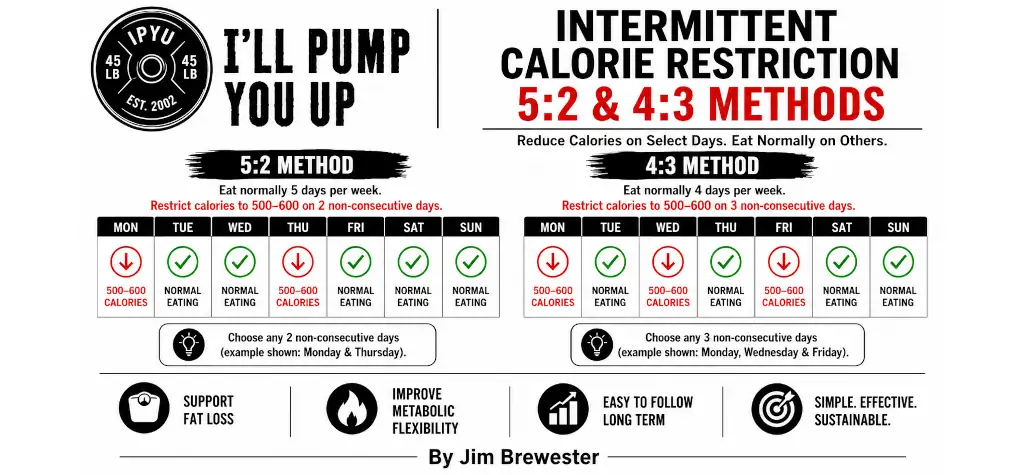
The 5:2 approach allows you to eat normally for five days each week; then restrict your calories to 500 for women and 600 for men on two non-consecutive days. (4)
Of course, as a serious lifter you are no doubt eating a reasonably clean, high-protein diet. However, if fat loss is your goal, you are most likely eating a little more than you should be, and want to focus on cutting calories. Always start with sugary carbs and unhealthy fats. I’ve said this before: never, ever cut protein. You can switch to lower fat sources, but never cut your protein intake.
Again for the sake of clarity, any serious lifter should be consuming at least 1 gram of quality protein per pound of bodyweight.
Weekly Schedule Examples
Here are a couple of popular options using the 5:2 Method.
- Monday and Thursday Split: Eat normally on Tuesday, Wednesday, Friday, Saturday, and Sunday, while restricting your calories on Monday and Thursday.
- Monday and Friday Split: Maintain standard eating habits on Tuesday, Wednesday, Thursday, Saturday, and Sunday, while choosing Monday and Friday as your two low-calorie days.
- If you are a non-lifter, or a beginning lifter, I advise making sure your diet is relatively clean on the 5 normal days, as noted above. If you eat tons of junk food or fast food, I suggest cleaning that up. Your efforts to lose body fat will be far more successful.
- This shouldn’t need to be said, but on your 5 normal days, do not try to make up the calories you didn’t eat on your 2 ICR days.
Meal Examples
- Two-Meal Split (200 / 300 calories per meal) – Have a 200-calorie breakfast (such as eggs or low fat, low-to-no-sugar Greek yogurt) and a 300-calorie dinner focused on lean protein and fiber. Your 2 meals should be high in protein.
- Low-Calorie Nutrient-Dense Foods – Focus on high-volume, low-calorie choices like leafy greens, steamed vegetables, and oven-baked salmon or chicken.
What About Protein?
Ah, yes, the critical question. First of all, as noted most of your meals should consist of low fat protein sources. Secondly, focus on vegetables. Why? Veggies are low in calories and are a fibrous carbohydrate, meaning they are not easily digested (if at all) by the body. Below you will see an example table listing various veggies.
| Vegetable | Serving Size | Preparation | TotalCalories | Calories Left (500 Budget) | Dietary Fiber |
| Celery | 1 cup (100g) | Raw, chopped | 14 kcal | 486 kcal | 1.6 g |
| Cucumbers | 1 cup (104g) | Raw, with peel | 16 kcal | 484 kcal | 0.6 g |
| Romaine Lettuce | 2 cups (94g) | Raw, shredded | 16 kcal | 484 kcal | 2.0 g |
| Zucchini | 1 cup (124g) | Raw, chopped | 21 kcal | 479 kcal | 1.2 g |
| Cauliflower | 1 cup (124g) | Boiled, drained | 28 kcal | 472 kcal | 2.8 g |
| Cabbage | 1 cup (150g) | Boiled, drained | 34 kcal | 466 kcal | 4.1 g |
| Bell Peppers | 1 cup (149g) | Raw, chopped | 39 kcal | 461 kcal | 3.1 g |
| Asparagus | 1 cup (180g) | Boiled, drained | 40 kcal | 460 kcal | 3.6 g |
| Spinach | 1 cup (180g) | Boiled, drained | 41 kcal | 459 kcal | 4.3 g |
| Green Beans | 1 cup (125g) | Boiled, drained | 44 kcal | 456 kcal | 4.0 g |
| Kale | 1 cup (130g) | Boiled, drained | 49 kcal | 451 kcal | 4.1 g |
| Broccoli | 1 cup (150g) | Boiled, drained | 54 kcal | 446 kcal | 5.1 g |
| Brussels Sprouts | 1 cup (156g) | Boiled, drained | 56 kcal | 444 kcal | 4.1 g |
| Artichoke Hearts | 1 cup (168g) | Boiled, drained | 89 kcal | 411 kcal | 14.4 g |
That leaves most of your calorie allotment for protein, as follows:
| Protein Source | Standard Serving | Total Calories | Protein (g) | Calories per30g Protein |
| Turkey Breast (lean deli) | 4 oz (113g) | 118 | 22 | 161 |
| Cod or Whitefish (baked) | 4 oz (113g) | 119 | 25 | 143 |
| Egg Whites | 1 cup (243g) | 126 | 27 | 140 |
| Greek Yogurt (0% plain) | 1 cup (227g) | 130 | 23 | 170 |
| Shrimp (cooked) | 4 oz (113g) | 135 | 27 | 150 |
| Tuna (canned in water drained) | 4 oz (113g) | 145 | 28 | 155 |
| Cottage Cheese (1% plain) | 1 cup (226g) | 163 | 28 | 175 |
| Chicken Breast (boneless skinless cooked) | 4 oz (113g) | 186 | 35 | 159 |
| Tofu (extra firm) | 1 cup (252g) | 197 | 20 | 296 |
| Rule 1 Clear Isolate | 1 Serving | 90 | 20 | 135 |
As you can see, I added a clear isolate protein powder – low in calories, carbs, and fat with 20 grams of whey isolate per serving. That’s a great addition to this plan!
Intermittent Calorie Restriction – The 4:3 Method
The 4:3 approach allows you to eat normally for 4 days each week; then restrict your calories to 500 for women and 600 for men on three non-consecutive days.
Weekly Schedule Examples
- Monday / Wednesday / Friday Option – As with the 5:2 Method, I suggest a 500 calorie restriction for women, 600 for men. It could occur on Monday, Wednesday, and Friday. Normal eating as discussed above on Tuesday, Thursday, Saturday, and Sunday.
- Tuesday / Thursday / Sunday Option – In this case, calorie restriction occurs on Tuesday, Thursday, and Sunday. Normal eating happens on Monday, Wednesday, Friday, and Saturday.
Nutritional Focus
- Intermittent Calorie Restriction Days – On these days, follow the same nutritional approach as with the 5:2 Method.
- Normal Eating Days – I can’t emphasize enough – eat a clean, high protein diet. The average lifter most likely is (or should be). However it bears repeating for those individuals that don’t give much thought to what they eat.
The Benefits of Intermittent Calorie Restriction
Simplicity
Many people find it easier to diet as well as track their calorie and macronutrient intake only a few days a week rather than counting this info every single day. However, it makes sense to use a journal or an app to stay on top of your calories and macronutrient breakdown.
Fat Loss
Over a 3-6 month period of time, both of these intermittent calorie restriction methods produce comparable reductions in body fat when compared to the continuous daily calorie restriction approach. (5)
Metabolic Health
These methods can help improve insulin sensitivity, lower triglycerides, and lower inflammation markers.
Considerations and Drawbacks
Sustainability
It most likely will become hard to continue this for a long period of time. It’s not meant for that anyway. Once you’ve gotten where you want to be, you’ll want to switch to a high protein, moderate carb maintenance plan. Also, serious lifters can and should eat more carbs in the hours around their workouts to ensure enough ATP training energy.
Side Effects
These methods may cause temporary hunger, irritability, fatigue, or difficulty concentrating on low-calorie days. I advise not working out on these days, other than some cardio as desired.
3 Rules for Keeping Muscle While Following an Intermittent Calorie Restriction Program
I know most of you are lifters, but this section is meant for those that are for new lifters.
- Lift weights 2-3 days per week.
- Eat at least 1 gram of protein per pound of bodyweight.
- Only restrict calories during the Intermittent Calorie Restriction days.
- Keep your protein intake as high as possible.
Supplements That Can Help
I have already suggested Rule 1 Clear Isolate for your restricted calorie days. In general, I also suggest the following:
- Hi-Tech Precision Protein – Here’s an innovative hydrolyzed whey protein powder that can help you maintain your muscle mass while dieting. One of the ways it does that is through leucine release in the early stages of protein synthesis.
- NutraBio Base – Here’s a “Core” pre-workout that gives you good results at a fraction of the typical cost of other pre-workouts.
- AllMax Nutrition VITASTACK – If you’re cutting calories you’re losing nutrients. Stay on top of that with this exceptional 7-complex multivitamin/mineral formula.
Optional:
- Hi-Tech Lipodrene – If fat loss is your goal, this is one of the very best thermogenic fat burners on the market, bar none.
- AllMax Nutrition Creatine – Here’s another way to help prevent muscle loss while dieting.
- NutraBio EAA Pure – As with creatine, here’s yet another way to preserve muscle. After all, you do want to lose fat and keep your muscle mass, right?
Summary
In this article we’ve seen the benefits of Intermittent Calorie Restriction, specifically using the 5:2 method and 4:3 method. There are other ways to use this concept, but these two are easy to follow: you don’t have to severely restrict calories every single day. All that’s left is to follow the tips presented here. Don’t forget to stop and shop at illpumpyouup.com for all your supplement needs. Then go out and make it happen!
References:
- https://ajcn.nutrition.org/article/S0002-9165%2822%2903032-5/fulltext
- https://www.health.harvard.edu/healthy-aging-and-longevity/fasting-vs-calorie-restriction-for-weight-loss-which-one-wins
- https://www.hopkinsmedicine.org/health/expert-qa/intermittent-fasting-what-is-it-and-how-does-it-work
- Bowen, J., Brindal, E., James-Martin, G., & Noakes, M. (2018). Randomized Trial of a High Protein, Partial Meal Replacement Program with or without Alternate Day Fasting: Similar Effects on Weight Loss, Retention Status, Nutritional, Metabolic, and Behavioral Outcomes. Nutrients, 10(9), 1145. https://doi.org/10.3390/nu10091145
- https://pmc.ncbi.nlm.nih.gov/articles/PMC7542333/
By Jim Brewster