

Running The QB/WR Route Tree
Running the QB/WR Route Tree involves running specific routes to build timing and chemistry between a quarterback and his wide receivers. Of course, this is critical for an effective offense that can put points on the board. In this article, we will take a good look at the route tree as well as practice drills and example routines specific to the skills required. Finally, I have provided nutritional and supplement tips for optimal performance. Without any further delay, let’s get right to it!
What Is The Route Tree?
In general, a route tree in football is a standardized numbering system that is used by coaches as well as players to lay out the precise path, direction, and yards a receiver should run on passing plays. The route tree serves as a standardized playbook so the quarterback and receivers are perfectly in sync. The basic route tree consists of 9 to 12 fundamental routes. These are the routes receivers must master and quarterbacks must learn for an effective passing game.
Route Tree Execution
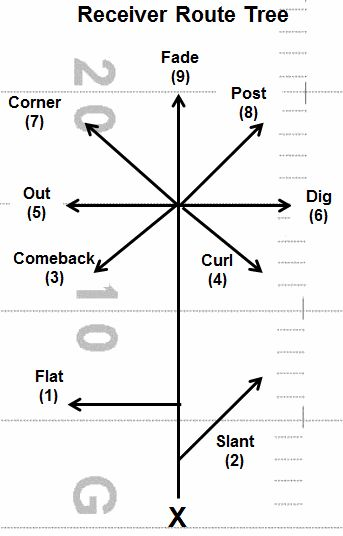
Mastering the route tree requires perfect timing: the quarterback must drop back and throw to a specific spot, while the receiver executes precise cuts at specific step counts to reach that spot. Below is an example of the standard numbered route tree (routes 1-9), which dictates the cut direction: odd numbers break out, even numbers break inside. (1, 2)
Route Tree Steps & Timing
1. Flat / Hitch Route – QB: 1 to 3 steps. The receiver stops, drops his hips, and sits in open space against zone coverage. This route typically takes advantage of the defense’s underneath coverage, thereby providing an easy target for the quarterback.
2. Slant Route – QB: 3-step drop. The receiver takes 1, 2, steps and a hard plant on the 3rd step for a sharp 45-degree cut across the middle. This is a quick pass often used in shirt-yardage situations.
3. Comeback Route – QB: 5-step drop. The receiver sprints 12 to 15 yards before breaking back toward the quarterback. This is an effective route against deep coverage.
4. Curl Route – QB: 3 to 5-step drop. The receiver works to 10-12 yards, abruptly stops, and turns back towards the quarterback. This is basically a reliable option for the QB.
5. Out Route – QB: 3-step drop (short) or 5-step drop (deep). The receiver drives to 10-12 yards, drops his hips, and makes a sharp 90-degree cut toward the sideline. Ideal for the 2-minute offense.
6. Dig Route – QB: 5-step drop. The receiver runs a vertical stem to 12 to 15 yards and cuts cleanly across the middle. This route is meant to take advantage of gaps in the defense’s intermediate coverage.
7. Corner Route – QB: 5-step drop. The receiver pushes vertically, breaks at a 45-degree angle toward the sideline pylon. A good deep option for the QB.
8. Post Route – QB: 7-step drop. The receiver sells the vertical fade then breaks inward at a 45-degree angle behind underneath coverage. Meant to attack the middle of the field.
9. Go / Fade Route – QB: 5 to 7-step drop. The receiver runs down the sideline at full speed. This is a stretch-the-defense play. (3, 4)
WR/QB Route Tree Practice Drills
Step Counting Drill
Both QB & WR: The QB and WR focus on counting inside/outside steps instead of watching the ball. The WR stays vertical until the specific break step so the DB cannot predict the cut.
Cone Explosion Drill
WR: Set up by placing cones at 8 to 10 yards. This drill allows the receiver to practice quick pivoting, opening the hips, and accelerating out of the break.
Medicine Ball Slam
WR: The WR holds a medicine ball above their head, balances on one leg, and slams the ball down to build the explosive single-leg strength needed to drop into breaks.
Lifting
To improve your execution of the route tree, the best approach is an explosive, position-specific weightlifting program. QB’s will need to focus on rotational power and leg drive. WR’s will need to emphasize fast-twitch muscle fiber single-leg explosiveness and rapid deceleration. For those of you used to basic bodybuilding-style workouts, the following routines will seem unusual, but are necessary for football excellence.
Quarterback (QB) Lifts: Rotational Force & Throwing Power
Specific lifts can drastically improve quarterback mechanics. The QBs power comes from the lower body and core, not the arm (like you might think). QBs should avoid heavy, overhead lifting that restricts shoulder mobility. Below are some example exercises:
- Kettlebell Russian Twists: Develops the core rotational force needed to transfer energy from your hips to your throwing shoulder.
- Barbell Reverse Lunges: Builds single-leg stability to help you throw accurately on the run.
- Quarter-Squat Jump Squats: Targets the exact leg extension and hip drive used to generate throwing power in the pocket.
- Do not lift heavy the day before a heavy route tree session.
Here’s How It Looks – Example Routine
This routine includes other exercises besides the ones listed above in order to represent an accurate example.
Barbell Back Squat
20% 1RM x 15 reps
40% 1RM x 10 reps
50% 1 RM x 10 reps
3 sets x 5 reps
Quarter-Squat Jump Squats
3 sets x 8 reps / Use a light weight (20% to 50% 1RM)
How to do this exercise:
Starting Position – Stand with your feet shoulder-width apart. Brace your core tightly and lower your hips slightly to about a quarter-squat depth.
The Jump – Explode upward instantly and forcefully, driving through your entire foot and extending your hips, knees, and ankles.
The Landing – Land softly on the balls of your feet, immediately bending your knees and hips to absorb the shock and protect your joints.
Repetitions – Reset entirely between jumps for maximal power, or perform continuously if focusing on the stretch-shortening reflex. (5)
Barbell Reverse Lunges
3 sets x 8 reps
Standing Calf Raises
2 sets x 12 reps
Seated Calf Raises
2 sets x 12 reps
Kettlebell Russian Twists
3 sets x 12 reps per side
Notes
This is a reasonably basic routine, with Jump Squats being the only exception. For this or any exercise that is new to you, focus on correct form before using a lot of weight.
Wide Receiver (WR) Lifts: Explosiveness & Deceleration
Every route in the route tree—from deep posts to sharp outs—relies on the WR’s ability to stop on a dime, sink their hips, and explode off their plant foot. The following exercises are examples a receiver might use:
- Single-Leg Hang Cleans: Increases fast-twitch muscle fibers to improve acceleration and explosive cuts.
- Heel-Elevated Split Squats: Strengthens your knees and hips for those violent, 90-degree cuts at the top of a route (like a comeback) without risking injury.
- Single-Leg Box Jumps: Mimics the exact motion of planting and separating from a defensive back.
- Aim for 2 days a week of lower-body power.
Here’s How It Looks – Example Routine
Hang Cleans
20% 1RM x 15 reps
40% 1RM x 10 reps
50% 1 RM x 10 reps
3 sets x 5 reps
Heel Elevated Split Squats
3 sets x 8 reps
Single-Leg Box Jumps
3 sets x 5 reps
Notes
This routine is very specific and may be hard to do. For any WR not used to these exercises, learning the correct form is first and foremost. Form first, adding weight second!
Nutritional Guidelines
The nutritional guidelines for quarterbacks and wide receivers look similar: (6)
WR’s
For wide receivers, I recommend 1 to 1.5 grams of lean proteins and 3-4 grams of quality carbohydrates per pound of bodyweight. Wide receivers should consume approximately 3,800-4,000 calories per day.
QB’s
For quarterbacks, I recommend 1 to 1.5 grams of quality protein sources and 3-4 grams of quality carbohydrates per pound of bodyweight. Quarterbacks do not need quite as many calories as a WR, therefore I suggest 3,000 to 3,500 per day.
Supplements Tips
For both QBs and WRs, I suggest using a protein powder, such as Klout Cravings Whey Protein, with 23 grams of whey concentrate and isolate per serving, low carbs, low fat, and a dessert-like taste. If you are training for more mass, then I suggest Hi-Tech Precision Protein. Why? Because it is specifically designed to enhance protein synthesis, a key trigger of muscle growth.
To help QB’s and WR’s meet their carb goals, especially on training days, I suggest EFX Sports Karbolyn, a fast digesting carb source that will give you sustained energy without insulin spikes. I also suggest Liquid I.V. Hydration Multiplier to support hydration – absolutely critical for any football player.
From there, I advise NutraBio EAA Pure during your lifting sessions for anabolic support, AllMax Nutrition Creatine for ATP energy as well as improved strength and power. Also, I advise a good multi, such as Myogenix Myo Vite, to shore up any nutritional deficiencies. Finally, I suggest a good pre-workout, such as Gorilla Mind Gorilla Mode, one of the best Pre’s on the market.
Summary
In this article, Running the QB/WR Route Tree, we reviewed the actual routes used in football. We also included specific drills and exercises that help optimize quarterback and wide receiver effectiveness. Finally, we looked at nutritional guidelines and supplement suggestions. All that’s left is to stop by illpumpyouup.com and stock up, then hit the field and get to work!
References:
- https://footballpipelines.com/ultimate-guide-to-wide-receiver-routes/
- https://athletesuntapped.com/blog/the-blueprint-of-open-grass-mastering-the-route-tree-in-football/
- https://gorout.com/football-route-tree/
- https://www.thephinsider.com/2016/6/20/11975890/football-101-wide-receiver-route-tree
- https://www.catalystathletics.com/exercise/426/Quarter-Back-Squat-Jump/
- https://nutritionhealthworks.com/nutrition-blog/proper-nutrition-football-players/